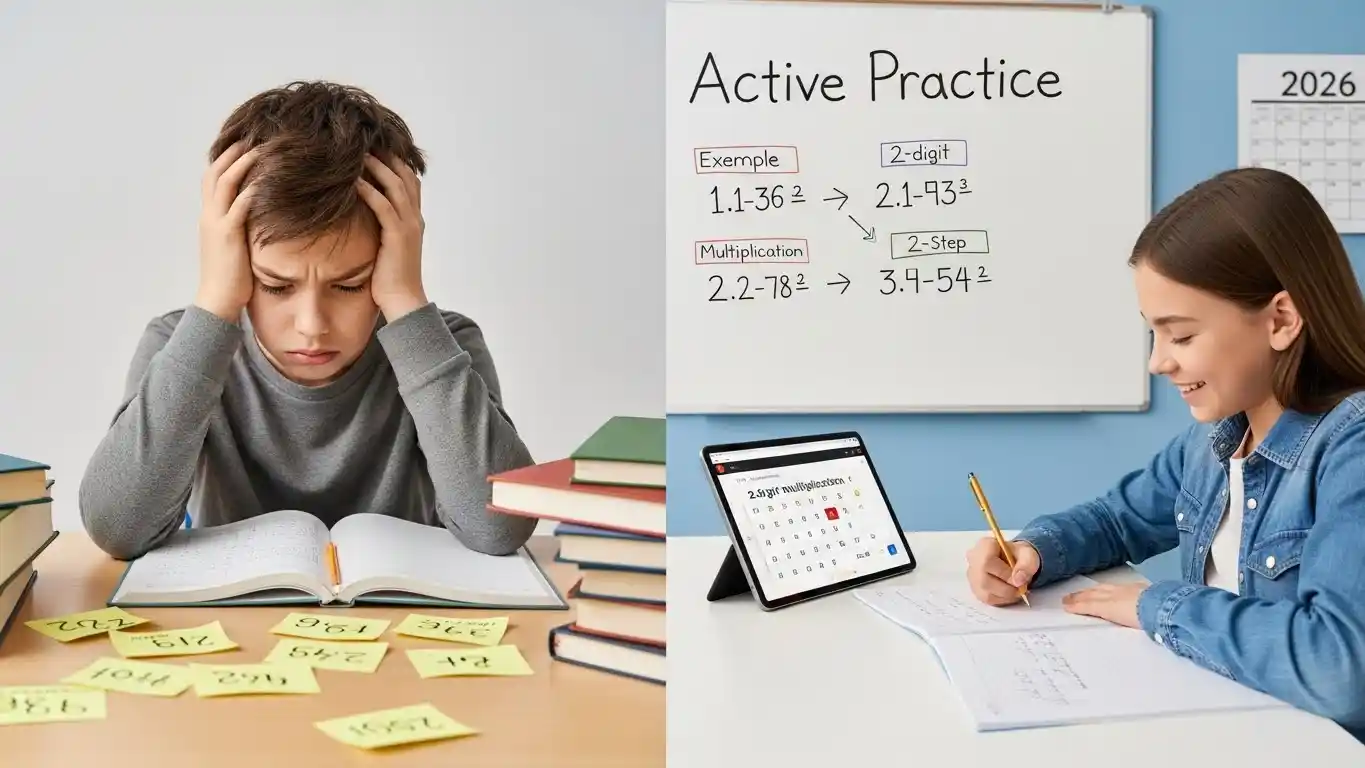
"It usually happens around mid-October. Your child comes home with a worksheet full of problems like 502 - 147. They sit down, they stare, and then the tears start. 'I don't get it!' they cry."
Hi everyone, Ronit Shill here, founder of ToolsBomb.
I have seen this scene play out in homes and classrooms everywhere. Subtraction with regrouping (what we used to call "borrowing") is arguably the single biggest hurdle in elementary school math.
Why? Because it demands that a child understands three things at once: Place Value, Subtraction Facts, and the abstract concept that Numbers Can Change Form.
If the traditional "cross it out and write a 1" method isn't clicking for your child, stop pushing it. It's time to try the "Regrouping Hack."
Why "Borrowing" is Confusing
First, let's look at the language we use. The word "borrow" implies you are going to give it back. But in subtraction, you never give it back!
When a child sees 2 - 7 in the ones column, their brain panics. A common mistake is to simply flip the numbers and do 7 - 2 = 5.
This happens because the standard algorithm (the vertical way) hides the actual value of the numbers. The "5" in 52 isn't just a 5; it's 50. But the child doesn't see that.
The Hack: "The Box Trick" (Expanded Form)
The solution is to make the invisible numbers visible. We call this the Expanded Form Strategy.
Let's take the problem 52 - 38. Here is how you teach it, step-by-step:
Step 1: Expand the Numbers
Don't write them stacked yet. Break them apart.
- (30 + 8)
Step 2: Ask the "Big Question"
Ask your child: "If you have 2 cookies, can you give me 8?"
They will say "No."
Step 3: The "Bank" Transaction
Say: "Okay, let's go to the bank (the tens place). We have 50 there. Let's take 10 out."
- Cross out 50. Write 40.
- Move that 10 over to the 2. Now we have 12.
Step 4: Subtract the Pieces
Now it's easy:
- 12 - 8 = 4
- 40 - 30 = 10
- Answer: 10 + 4 = 14
This "hack" works because it turns a magic trick into logical math. Once they master this, the standard way makes total sense because they understand why they are putting a little '1' next to the 2.
Practice Makes Permanent
Once the concept clicks, they need repetition. Generate unlimited, free subtraction worksheets tailored for 3rd graders instantly.
Create WorksheetsThe "ToolsBomb" Philosophy: Confidence First
At ToolsBomb, we believe that math shouldn't hurt.
If your child is crying, stop. The learning center of the brain literally shuts down when stress hormones flood the system. You cannot teach a crying child.
Instead, take a break. Come back later and use the "Box Trick" with just three problems.
Why three? Because doing 3 problems correctly with confidence builds neural pathways better than doing 20 problems with frustration.
For Auditory Learners: The Poem
Sometimes, a catchy rhyme is all it takes to trigger the memory of what to do. Print this out and stick it on the fridge:
"More on top?
No need to stop.
More on the floor?
Go next door and get ten more.
Numbers the same?
Zero's the game."
Conclusion
Subtraction with regrouping is a major milestone. It's okay if it takes time.
By using visual strategies like Expanded Form and low-stress practice tools, you are giving your child the greatest gift of all: the belief that they can do hard things.
You've got this, parents.
Ronit Shill
Founder, ToolsBomb