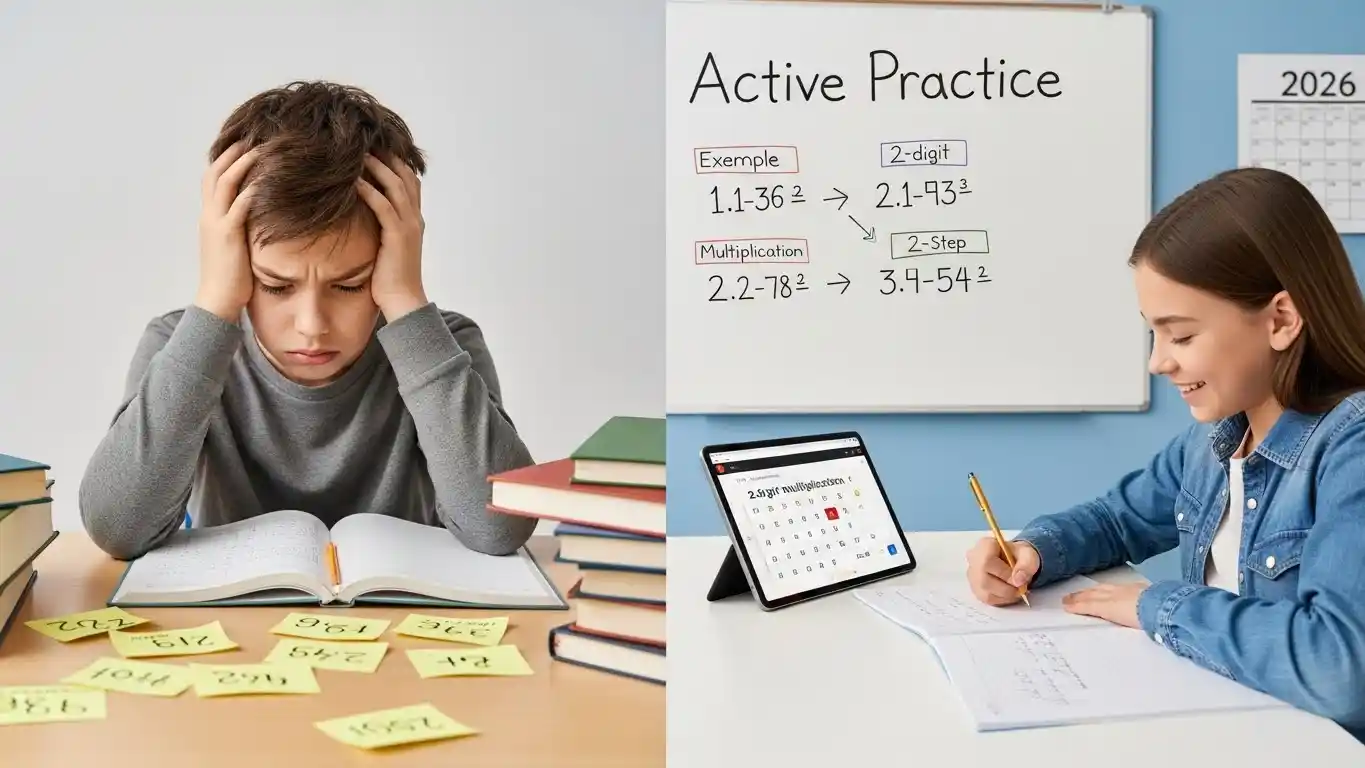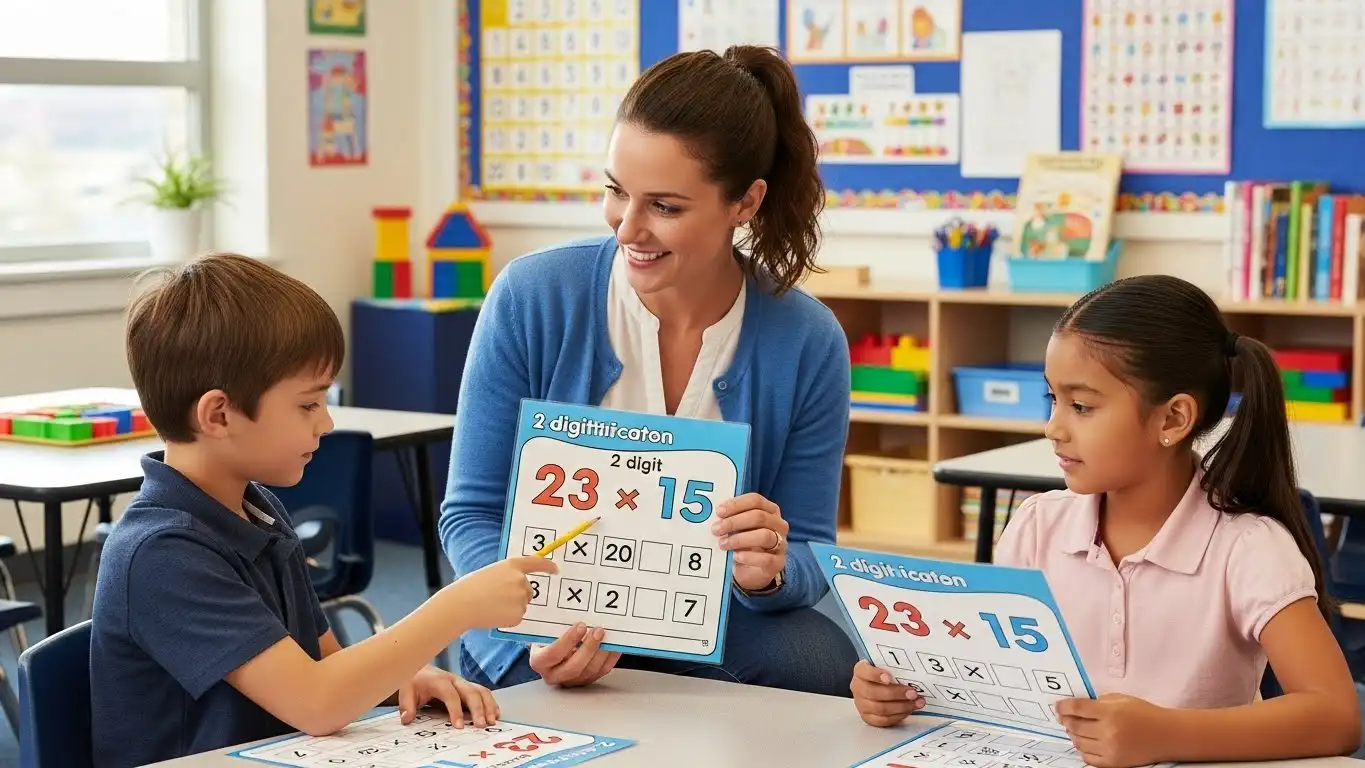
"Let’s be honest: the jump from single-digit multiplication to 2-digit by 2-digit multiplication is huge. For many 4th graders, seeing a problem like 34 × 26 triggers immediate anxiety."
Hi friends, Ronit Shill here, founder of ToolsBomb.
I remember when I was in 4th grade, my teacher would just say, "Put a zero here, multiply this, carry that." I did it, but I had no idea why. It felt like memorizing a magic spell. If I forgot one step, the whole spell failed.
Today, we know better. We know that students need to understand the logic behind the numbers. And more importantly, they need to have fun while doing it.
Here are my top 5 favorite strategies to make 2-digit multiplication click for your students (or kids!) without the tears.
1. The "Box Method" (Area Model)
Before you ever show them the vertical way (the standard algorithm), start with the box.
The Box Method is brilliant because it breaks scary big numbers into friendly small numbers.
- Draw a large square divided into 4 sections.
- Write
34as 30 + 4 on top. - Write
26as 20 + 6 on the side. - Multiply the corners: 30x20, 30x6, etc.
Suddenly, a hard problem becomes four easy problems. It connects math to geometry (area) and makes the concept of "partial products" visible.
2. Multiplication War (Card Game)
Gamification is the easiest way to trick the brain into learning. Grab a standard deck of cards (remove the face cards).
How to play:
- Two players sit facing each other.
- Each player flips two cards (creating a 2-digit number).
- They have to multiply their number by their opponent's number.
- Okay, that might be too hard for mental math! Instead, try "1-Digit War" first to build speed, or use a calculator to verify who has the higher product.
The competition makes them focus intensely on the numbers, building fluency without realizing they are "studying."
3. The "Turtlehead" Method
When you finally move to the standard vertical method, kids often forget the steps. Enter the Turtlehead story.
Draw a turtle head around the top two numbers and the bottom ones digit.
- Multiply everything inside the turtle's neck.
- Check off the carried numbers.
- Draw a collar (cross out the bottom ones digit).
- Lay an egg! (This is the most important part—drawing the zero placeholder).
It sounds silly, but "Did you lay the egg?" is a much more memorable prompt than "Did you add the zero placeholder?"
Need Practice Problems?
Games are great, but eventually, they need to write it down. Generate unlimited 2-digit multiplication worksheets instantly.
Get Free Worksheets4. Color-Coded Columns
For students with dyslexia or dysgraphia, keeping the numbers lined up is half the battle. If columns are crooked, the answer is wrong.
Use graph paper instead of lined paper. Or, use highlighters to color the vertical columns.
This visual guide acts as a guardrail, ensuring that the tens stay with the tens and the hundreds stay with the hundreds. It’s a simple accommodation that saves a lot of frustration.
5. The "Estimate First" Rule
Finally, teach them to be detectives. Before solving 32 × 28, ask them to guess the answer.
"Well, 30 times 30 is 900. So the answer should be around 900."
If they do the math and get 9,000 or 90, they instantly know something went wrong. This builds "Number Sense," which is far more valuable than just getting the right answer.
Conclusion
Math doesn't have to be a scary monster under the bed. With visual tools like the Box Method, silly stories like the Turtlehead, and consistent, low-stress practice, any student can master 2-digit multiplication.
Remember, the goal isn't speed. The goal is confidence.
Keep it fun, keep it light, and watch them soar.
Ronit Shill
Founder, ToolsBomb